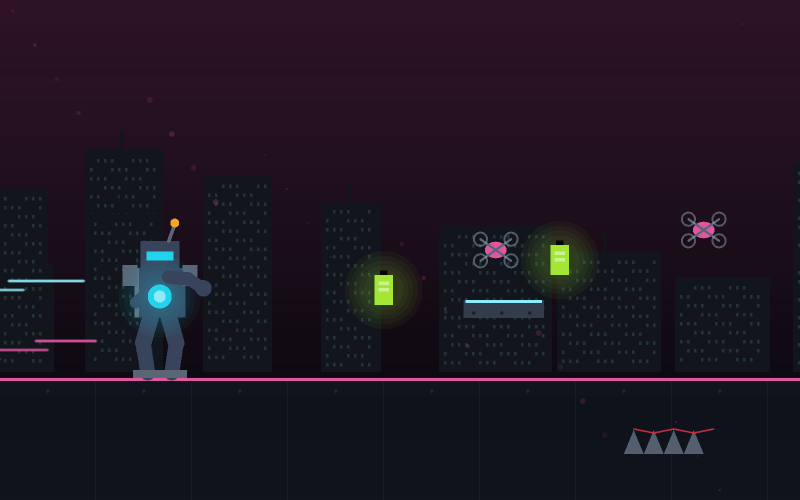

About robot racing & running games
Look at where you will be, not where you are
The instinct in a fast game is to watch your own machine. It is the thing you control and the thing that is about to crash, so your eyes go to it. This is the single biggest thing holding most players back in this category.
By the time an obstacle is next to you, every decision about it has already been made. The useful information is further up the screen, in the region you will reach in about a second. Deliberately moving your gaze forward feels wrong for the first few runs and then stops feeling like anything at all, and scores go up sharply when it does.
This is also why both games keep the player's machine toward the left or bottom of the screen rather than the centre. It is not an aesthetic choice - it exists to give you more of the screen in the direction you actually need to be reading.
Robot Dash: the speed is the difficulty curve
Robot Dash is an endless runner. You jump, you slide and you collect energy cells, and the only thing that changes over a run is how fast the city is moving past you. There are no new obstacle types at high speed, which matters more than it sounds.
It means the game never surprises you with something unfamiliar. Everything that kills you at ninety seconds also appeared at twenty seconds, when you had twice as long to deal with it. Practice is therefore genuinely transferable: an obstacle pattern you learn to read slowly is one you can still read fast.
The drone hazards are the exception worth calling out. They occupy the upper lane, which means the jump that clears a floor obstacle can put you directly into one. Reading two obstacles together rather than one at a time is the skill the game is really testing.
Robo Racer: checkpoints change what risk means
Robo Racer is not endless. There is a clock, there are checkpoints that add time, and there are rival machines that block lanes rather than shoot at you. That structure changes the calculation on every risk you take.
In an endless game, a crash ends the run and caution is almost always correct. With a clock, caution has a cost too - a safe line that loses you two seconds can miss a checkpoint and end the run just as surely as a crash would. The game is asking how much risk the remaining time justifies, and the answer changes every few seconds.
The practical version of this: early in a run, take the safe line. Late in a run with the clock low, take the boost pad even if it puts you in a crowded lane. Being timid is a way to lose that is easy to miss because it does not look like a mistake.
Why these games feel different on a phone
Both games are fully playable on touch and both were tested that way before they shipped. The honest caveat is that a smaller screen shows you less of the road ahead, and this is the category where that matters most, because reading ahead is the entire skill.
Nothing is unfair on a phone - the obstacle spacing is defined in the game's own coordinate space rather than in screen pixels, so the reaction time available is identical on every device. But a large screen gives you more comfortable margin, and it would be dishonest to pretend otherwise.
Tips for this category
- Move your gaze about a second ahead of your machine. This is worth more than any other single change you can make.
- In Robot Dash, read the floor obstacle and the drone above it as one problem, not two.
- A slide is faster to recover from than a jump. When you are unsure which one clears something, slide.
- In Robo Racer, take the safe line early and the risky line late. The clock makes caution expensive near the end.
- Never chase an energy cell into a lane you have not already read. The cell is worth less than the run.
- If you crash repeatedly at the same speed, you have found your actual skill ceiling - practise at that speed rather than restarting for a lucky run.