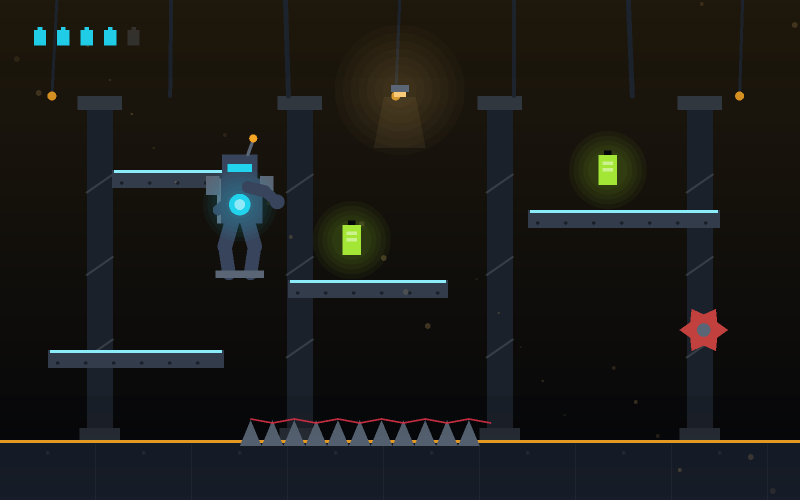
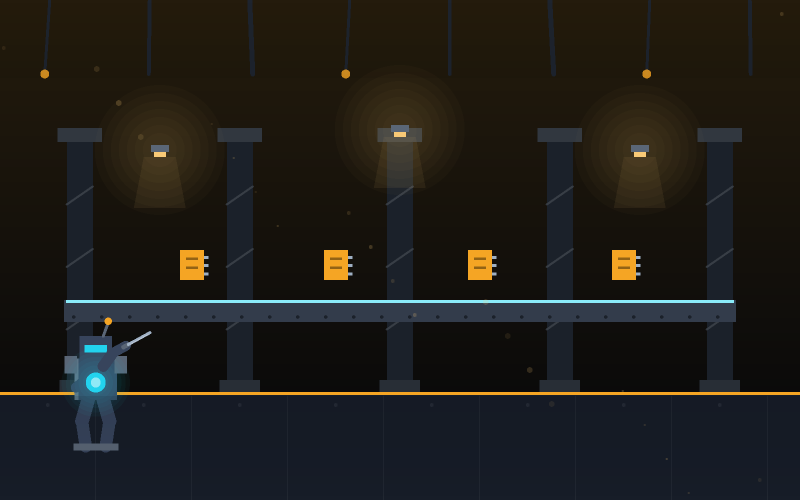
About Robo Racer
The clock makes caution expensive
In an endless game a crash ends the run, so caution is almost always correct. Robo Racer breaks that. There is a second way to lose - running out of time - and it does not look like a mistake while it is happening.
A safe line that costs you two seconds is not free. If it means missing a checkpoint, it ends the run exactly as surely as a crash. This is why experienced play here looks reckless from the outside: the risk of a crowded lane is real, but so is the risk of arriving at the next checkpoint two seconds after the clock ran out.
The practical rule is that risk tolerance should rise as the clock falls. Early in a run, with a comfortable margin, take the clean line. With eight seconds left, take the boost pad even if it puts you into traffic.
Rivals block, they do not attack
The other machines on the track are obstacles with behaviour rather than enemies. They do not shoot, they cannot be destroyed, and they are not trying to hit you. They drift between lanes on their own schedule and will happily occupy the space you were heading for.
That drift is predictable if you watch it. A rival that has just changed lanes will hold its new lane for a while; one that has been in the same lane for several seconds is due to move. Reading that is what separates a clean overtake from a collision that costs three seconds.
Collisions do not end the run. They cost time and speed, which in a timed game is a more interesting penalty than death - a crash is survivable but it makes the next checkpoint harder, which compounds.
Boost pads and the shape of a good run
Boost pads sit in specific lanes and give a burst of speed that both covers distance and raises your score rate. They are almost always placed in the lane that currently has the most traffic, because a boost you can take for free would not be a decision.
A good run is therefore not a smooth one. It looks like a series of calculations: this pad is worth the traffic, that one is not, this checkpoint is reachable without the pad, that one is not. Players who never take a risky pad plateau quickly.
Data chips are the low-risk alternative. They add score without adding speed, sit in quieter lanes, and are the right thing to collect when your time margin is comfortable and there is nothing better to do with the next few seconds.
Checkpoints, and why the margin matters more than the total
Each checkpoint adds a fixed amount of time rather than resetting the clock. That means a run is not really a sequence of separate sprints - the margin you arrive at one checkpoint with carries into the next.
Arriving at a checkpoint with nine seconds on the clock rather than four is worth far more than the score difference suggests, because it buys you the ability to take the safe line for the next stretch. Most long runs are built from a couple of early aggressive stretches that bank margin for later.
How to play
- Press Start. Your machine accelerates automatically down a four-lane track.
- Press Left and Right, or A and D, to change lane. Lane changes are instant but not free - you cannot change into an occupied lane.
- Press Up or W on a boost pad to take it for a burst of speed.
- Reach checkpoints to add time to the clock. Each adds a fixed amount rather than resetting it.
- The run ends when the clock reaches zero. Collisions cost time and speed but do not end it.
Controls
| Where | What to do |
|---|---|
| Change lane (desktop) | Left and Right arrows, or A and D |
| Boost | Up arrow or W while on a boost pad |
| Change lane (mobile) | The four-way pad, or swipe left and right |
| Pause | Escape or P |
| Restart | R, or the Restart button |
Scoring
These are the point values this game awards, before the combo multiplier is applied where it uses one. Hit quality changes the figure: a strike at the centre of the correct moment is worth substantially more than one at the edge of it.
Tips
- Let your risk tolerance rise as the clock falls. Playing safe with eight seconds left is how runs end.
- A rival that just changed lanes will hold it. One that has been still for a while is about to move.
- Boost pads are placed in busy lanes on purpose. Sometimes the traffic is worth it and sometimes it is not.
- Bank margin early. Arriving at a checkpoint with nine seconds is worth far more than arriving with four.
- Collect data chips only when your time margin is comfortable - they add score but no speed.
- After a collision, prioritise rebuilding speed over changing lanes. Speed is what reaches the checkpoint.
Common mistakes
- Treating the game like an endless runner and always taking the safe lane.
- Changing lanes into a rival that was already drifting that way.
- Chasing data chips when the clock is low - they add nothing that helps you reach a checkpoint.
- Taking every boost pad regardless of traffic, which is as much a fixed plan as taking none.
- Panicking after a collision and making a second mistake while speed is still low.
Features
- A clock that makes caution genuinely costly, not just a second failure state
- Rival machines with readable lane-change behaviour rather than random movement
- Boost pads deliberately placed in crowded lanes, so taking one is always a decision
- Collisions that cost time and speed rather than ending the run
- Checkpoints that add time rather than resetting it, so early margin compounds
- Best distance and best score stored in your own browser
Game information
| Genre | Robot Racing & Running - timed lane racing |
|---|---|
| Difficulty | Medium |
| Controls | Left/Right change lane, Up boosts |
| Recommended device | Anything. Comfortable on a phone, and the lane layout suits thumbs well. |
| Players | One player |
| Price | Free, with no account and nothing to unlock |
| Released | 2 April 2026 |
| Last updated | 18 August 2026 |