About Space Robot Rescue
Fuel is the whole game
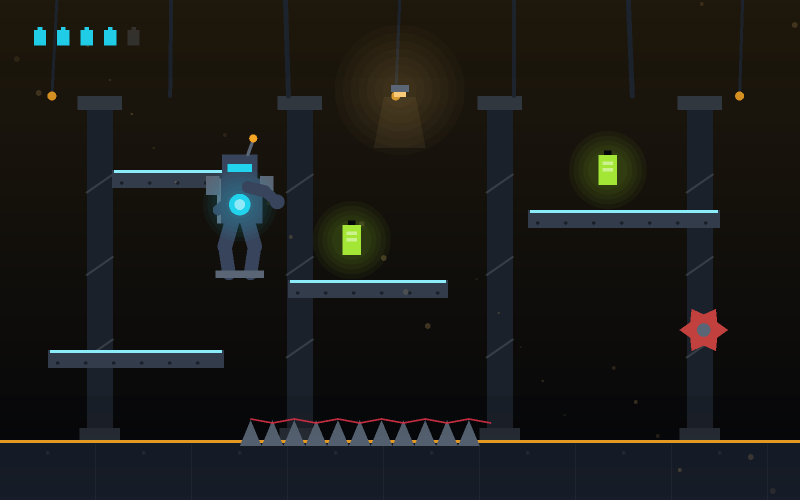
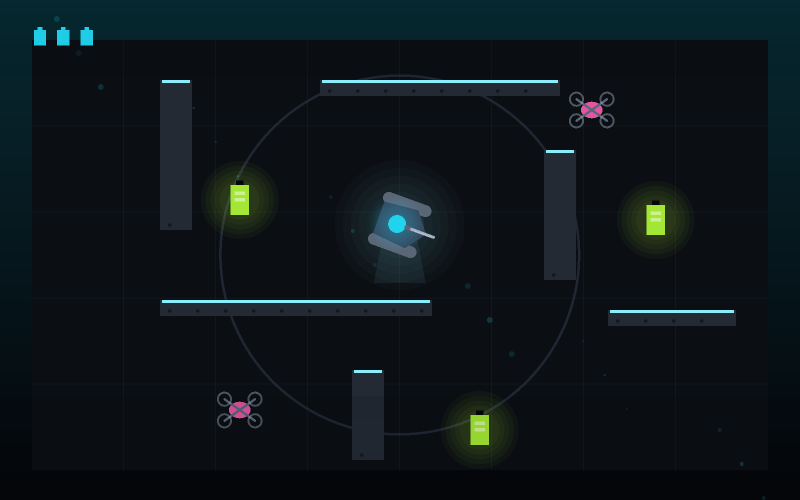
Your thruster burns fuel continuously while firing and the gauge refills only while you are standing on a surface and not moving. There is no fuel pickup anywhere in the station.
That single rule generates every interesting decision here. A distant robot is not simply far away, it is a round trip you must be able to complete, and the return leg is harder because you will be carrying a passenger that slows you down.
The failure that catches most people out is not running dry mid-flight, which at least happens visibly. It is arriving somewhere with a rescued robot, no fuel, and a hazard cycle that makes standing still to refuel unsafe. Planning the route home before committing to the route out is not cautious play, it is the game.
Low gravity means momentum is a resource
You drift. Releasing the thruster does not stop you, it just stops adding speed, and the station's gravity is light enough that a drift can carry you a long way for free.
Good play here looks lazy. A short burn to set a direction, then a long silent coast, then a short burn to correct - that route uses a fraction of the fuel of continuous thrust and arrives only slightly later. Players who hold the thruster down for whole crossings run out at around the third rescue.
Coasting also needs planning, because stopping costs fuel too. Arriving at a landing pad at speed means burning against your own momentum, which is why aiming to arrive slowly is worth more than arriving quickly.
Rescued robots follow, and can be lost
A rescued machine does not vanish into an inventory. It follows you, trailing slightly behind, and it can be hit by the same hazards you are avoiding. Losing one on the way home is the most demoralising thing that happens in this game and it is entirely preventable.
The practical consequence is that the route home is not the route out. A gap you threaded at speed is a gap your follower will arrive at a moment later, on a slightly different line. Debris fields that were fine to cross alone need a wider margin when something is behind you.
You can carry up to three at once. The third one makes the trailing line long enough that tight corridors become genuinely risky, and two safely delivered is very often worth more than three attempted.
The results screen tells you which mistake you made
Collected and delivered are counted separately. That is a deliberate piece of feedback rather than trivia: a run that collected six and delivered three was a routing problem, and a run that collected three and delivered three but scored poorly was a fuel problem.
Most improvement in this game comes from noticing which of those two patterns your runs fall into, because the fixes are completely different. One is about how many you pick up before turning back; the other is about how you fly.
How to play
- Press Start. Use the arrow keys or WASD to fire your thruster in that direction.
- Fuel burns while thrusting and refills only while you are landed and still.
- Fly to a stranded robot and press Space to attach it. It will follow you from then on.
- Return to the shuttle and press Space to deliver everything you are carrying.
- The stage ends when every robot is delivered or your integrity runs out.
Controls
| Where | What to do |
|---|---|
| Thrust (desktop) | Arrow keys or WASD |
| Attach / deliver | Space or E |
| Thrust (mobile) | The four-way pad under the game |
| Attach (mobile) | The Grab button |
| Pause | Escape or P |
Scoring
These are the point values this game awards, before the combo multiplier is applied where it uses one. Hit quality changes the figure: a strike at the centre of the correct moment is worth substantially more than one at the edge of it.
Tips
- Plan the route home before you commit to the route out. The return leg is the harder one.
- Burn briefly, then coast. Continuous thrust is what empties the gauge by the third rescue.
- Aim to arrive slowly. Stopping costs fuel, so arriving fast is a bill you pay on landing.
- Give hazards a wider margin when you have a follower - it arrives a moment after you, on a different line.
- Two delivered beats three attempted. The score only counts machines that reach the shuttle.
- Read the results screen: collected versus delivered tells you whether your problem is routing or flying.
Common mistakes
- Holding the thruster for a whole crossing instead of coasting between corrections.
- Picking up a third robot when the route home runs through a tight corridor.
- Landing at speed, which burns fuel braking that you needed for the return.
- Refuelling in a spot that a hazard cycle will reach before the gauge fills.
- Threading a debris gap on the line you used going out, with a follower behind you.
Features
- Fuel that regenerates only while landed and still, with no pickups anywhere
- Low-gravity drift that makes coasting genuinely more efficient than thrusting
- Rescued robots that follow and can be lost, so the route home differs from the route out
- A carry limit of three, where the third meaningfully changes what routes are safe
- Collected and delivered counted separately, so the results screen diagnoses the run
- Best score and best stage stored in your own browser
Game information
| Genre | Robot Adventure & Puzzle - low-gravity rescue |
|---|---|
| Difficulty | Hard |
| Controls | Arrows thrust, Space grabs and releases |
| Recommended device | Anything. Thruster control is a little finer with a keyboard than with a pad. |
| Players | One player |
| Price | Free, with no account and nothing to unlock |
| Released | 9 June 2026 |
| Last updated | 5 September 2026 |