About Cyber Robot Defense
Arrival time, not distance
The instinct in a defence game is to shoot whatever is closest to the core. This is wrong often enough to be the main thing holding most players back.
What matters is which machine will reach the core first, and that is a function of distance and speed together. A light strider at forty metres arrives before a brute at twenty, because the strider moves nearly three times as fast. Shooting the brute because it looks more threatening is how a core dies to something you never fired at.
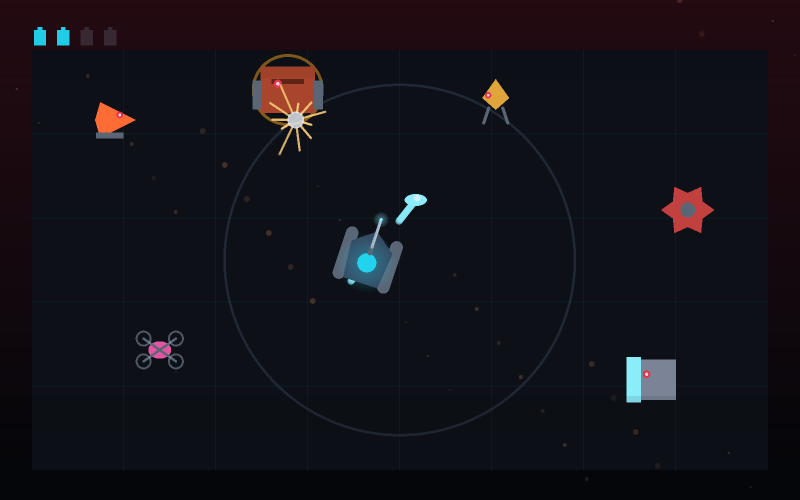
The game helps with this rather than hiding it. Each approach lane shows a thin marker at the position of its leading threat, ordered by arrival time rather than distance. Once you start reading those markers instead of the machines themselves, target priority becomes almost automatic.
Knowing what to let through
A single rusher reaching the core costs one point of core integrity out of twelve. Abandoning a lane to prevent that can easily cost three, because the lane you left now has a queue.
This is uncomfortable, because letting something through feels like failing. It is not. Defence games are won by minimising total damage, not by achieving a perfect record, and a player who never lets anything through is usually a player who is about to lose four points at once.
The rule of thumb that works: if stopping a leaker means turning away from a lane with two or more machines in it, let the leaker through. If the lane you would turn away from is clear, stop it.
Upgrades that change what you can do
Salvage is earned by destroying machines and spent between waves on four options. None of them is a flat damage increase, which is deliberate - an upgrade list where one option is simply 'more damage' makes the choice the same every game.
Faster reload changes how long you can hold a single lane before having to rotate. Piercing rounds change whether a queued lane is a problem at all. A repair buys back mistakes you have already made. The slow field changes arrival times, which means it changes your entire priority order for the rest of the run.
On a first run, reload speed is the strongest pick, because it most directly addresses the thing new players struggle with: not being able to deal with a lane fast enough to rotate to the next one.
Wave twelve, and what changes there
The first eleven waves escalate in a fairly predictable way. Wave twelve introduces shielded machines on two lanes simultaneously, and it is where most runs end for the first several attempts.
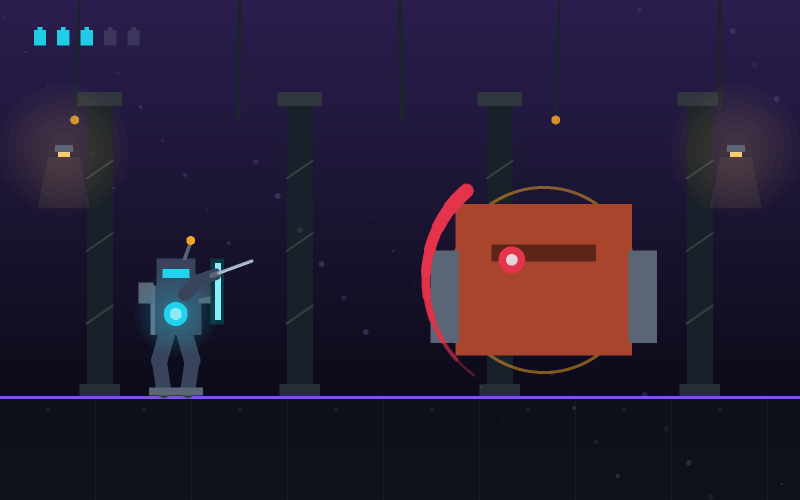
Shielded machines have a plate on their leading edge that absorbs shots from the front. They can be destroyed from the front, it just takes roughly three times as long, which in a defence game means the lane behind them backs up badly.
The answer is piercing rounds if you have them, and repositioning if you do not - the plate only covers the direction the machine is facing, so shooting a shielded machine as it turns into its lane is dramatically more effective than shooting it head-on.
How to play
- Press Start. Machines advance toward the reactor core down three approach lanes.
- Aim with the mouse and hold the left button to fire. The turret tracks your cursor continuously.
- Destroy machines to earn salvage. Between waves, press 1 to 4 to buy an upgrade.
- The core has twelve integrity. Each machine that reaches it costs one or more.
- The run ends when core integrity reaches zero. Press Restart or R to go again.
Controls
| Where | What to do |
|---|---|
| Aim and fire | Mouse to aim, hold left button to fire |
| Buy upgrades | Keys 1 to 4 between waves, or click the cards |
| Touch | Drag to aim, tap the fire button, tap a card to buy |
| Pause | Escape or P |
| Restart | R, or the Restart button |
Scoring
These are the point values this game awards, before the combo multiplier is applied where it uses one. Hit quality changes the figure: a strike at the centre of the correct moment is worth substantially more than one at the edge of it.
Tips
- Read the lane markers, not the machines. They are ordered by arrival time, which is what actually matters.
- Let a single weak machine through rather than abandoning a lane with two or more in it.
- Buy reload speed first on an early run. It fixes the problem of not being able to rotate in time.
- Shoot shielded machines as they turn into a lane - the plate only covers the way they face.
- Spend salvage every wave. Salvage saved for a wave you do not survive is salvage wasted.
- Wave twelve puts shielded machines on two lanes at once. Plan for it from wave ten.
Common mistakes
- Shooting the closest machine instead of the one that will arrive first.
- Trying to achieve a perfect no-leak run and losing four points in one lane as a result.
- Hoarding salvage for an expensive upgrade instead of buying what helps now.
- Firing into a shielded machine's plate head-on and letting its lane back up behind it.
- Holding fire between waves - the turret does not overheat and there is no ammunition.
Features
- Three approach lanes with markers ordered by arrival time rather than distance
- Twelve points of core integrity, so leaks are survivable and triage is a real decision
- Four upgrades that each change how you play rather than adding flat damage
- Shielded machines whose plate only protects the direction they face
- Hand-built wave recipes, so waves can be learned and planned for
- Best wave and best score stored in your own browser
Game information
| Genre | Mech & Robot Action - base defence |
|---|---|
| Difficulty | Hard |
| Controls | Mouse aims and fires, 1-4 buys upgrades |
| Recommended device | Best with a mouse. Playable on touch, though target-switching is slower with a thumb. |
| Players | One player |
| Price | Free, with no account and nothing to unlock |
| Released | 24 February 2026 |
| Last updated | 28 August 2026 |